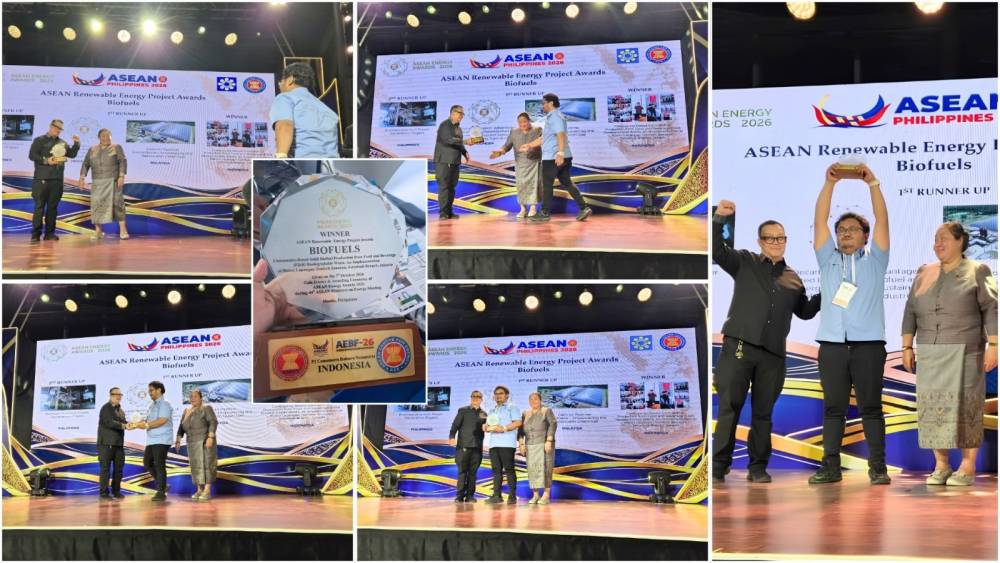
Comestoarra Wins First Prize at ASEAN Renewable Energy Awards 2026 for TOSS and DHYRECS Project at BLTS.
Manila (MEBI NEWS) - PT Comestoarra Bentarra Noesantarra (Comestoarra) has won first prize in the Biofuel category of the ASEAN Renewable Energy Project Awards at the ASEAN Energy Awards 2026, securing top regional recognition for its community-based waste-to-energy project in Jakarta.
The award ceremony, organised by the ASEAN Centre for Energy (ACE), took place at Museo del Galeón on Sunset Avenue in Pasay City, Metro Manila, Philippines, on Wednesday, October 7, 2026. Comestoarra stood out as the only startup and small and medium-sized enterprise (SME) in Southeast Asia to receive the top honour at the event.
Its winning project, “Community-Based Solid Biofuel Production from Food and Beverage (F&B) Biodegradable Waste: An Implementation at Bakso Lapangan Tembak Senayan Setiabudi Branch, Jakarta,” placed ahead of major companies from Malaysia and the Philippines, which finished as first and second runners-up, respectively. Despite its small scale and community focus, the project’s use of Teknologi Olah Sampah di Sumbernya (TOSS), a technology for processing waste at its source, and the Distributed Hybrid Renewable Energy System (DHYRECS) at the Setiabudi branch of Bakso Lapangan Tembak Senayan (BLTS) reinforced Comestoarra’s position as a regional leader in biofuel innovation.
Comestoarra Managing Director Arief Noerhidayat expressed gratitude and pride in the achievement. This is the company’s second award in consecutive years. In 2025, Comestoarra won the Waste-to-Energy category for “The Development of a Community-Based Waste-to-Energy Facility and the Utilization of the Product for a Distributed Hybrid Renewable Energy System That Charges Electric Boats,” implemented on Kemaro Island in Palembang, South Sumatra.
“Praise be to God. After years of work since 2019, this highly decentralised innovation has finally received recognition across Southeast Asia. Our process of converting waste into biofuel through biodrying has undergone research, trials and implementation at several pilot projects. That work has now been recognised through this ASEAN Renewable Energy Award,” Arief said, visibly moved.
Arief said Comestoarra’s progress had involved overcoming considerable scepticism, particularly about economic viability. Many had doubted that small-scale projects could generate a profit. He argued, however, that achieving decarbonisation and the energy transition requires collective action.
“I firmly believe in the commutative property of multiplication: 1,000 × 1 equals 1 × 1,000. In other words, processing 1,000 tonnes of waste per day at a centralised facility is equivalent, in total capacity, to processing one tonne per day at each of 1,000 decentralised locations. The same principle applies to renewable energy. Building a 1,000-megawatt renewable energy plant at one location provides the same total capacity as building one-megawatt plants at 1,000 locations,” he explained.
He added that the greatest challenge today lies in perceptions of waste-to-energy and renewable energy implementation, rather than in the technology itself. Some stakeholders at both national and global levels remain focused on large-scale projects, assuming that economic value and significant impact require centralised facilities and substantial investment. As a result, small community initiatives are often overlooked, regarded as unbankable and questioned over their long-term viability. Arief argued that decentralised systems can strengthen energy resilience while addressing waste directly at its source.
“Comestoarra sees a connection between converting waste into biofuel and generating renewable energy. We therefore developed DHYRECS to use biofuel produced from organic waste and biomass residues through TOSS. The biofuel is then converted into synthesis gas using mini-gasification technology developed by Comestoarra,” Arief said.
Biodegradable waste, consisting largely of organic material and biomass residues, can be processed into biofuel and converted into synthesis gas, or syngas, through gasification. The gas can replace petroleum-based fuel in electricity generators. The electricity produced can be stored in batteries within a system that also incorporates renewable energy technologies such as solar panels. This hybrid approach helps address solar intermittency and continuity-of-supply challenges associated with biofuel-based energy.
“The implementation at BLTS in Setiabudi, Jakarta, demonstrates that TOSS and DHYRECS can deliver benefits beyond a project’s financial returns. Food waste from the restaurant and biomass residues collected from the surrounding area are processed into biofuel. The biofuel is periodically converted into synthesis gas using a mini gasifier to replace petroleum-based fuel in an electricity generator, and the electricity produced is stored in batteries,” Arief said.
“To improve reliability, Comestoarra also installed solar panels, with their electricity stored in the batteries as well. The stored electricity powers the TOSS equipment, while surplus power is used for lighting around the BLTS premises,” he added. Arief holds a Master of Science in Management from Northumbria University in the United Kingdom and a bachelor’s degree in Communication, specialising in Journalism, from Universitas Padjadjaran in Indonesia.
With ASEAN Energy Awards in two consecutive years, Comestoarra aims to demonstrate that decentralisation does not mean disregarding financial viability. Instead, the approach can create economic opportunities for local communities, reduce logistics costs and accelerate progress towards decarbonisation and the energy transition without waiting for major infrastructure projects that take years to build.
Arief hopes the regional recognition will encourage more stakeholders to assess community-based projects comprehensively, taking their broader impact into account. He called for a shift in perspective and collective action at every scale, arguing that equitable access to clean energy and sustainable environmental management depend on a willingness to support initiatives both large and small.